
THE MAJOR PROJECT: PRESERVING NUREMBERG'S ZEPPELIN GRANDSTAND
“The grandstand is full of surprises.” That is how Robert Minge succinctly describes it. And he should know: as an architect at the City of Nuremberg's Building Construction Office, he heads the Department of Cultural Buildings, which is responsible for the Zeppelin Grandstand. Working alongside him is Dr. Matthias Braun. The historian from the City of Nuremberg's Department of Cultural Affairs, which was led for many years by Prof. Julia Lehner, is responsible for providing the historical and educational context of the major project *Preservation of the Zeppelin Grandstand and the Zeppelin Field*. Everyone involved agrees: “This project can only succeed if we accept that it is greater than the sum of its individual parts. It requires everyone to work together toward a common goal.” Teamwork is therefore at the heart of the project, with numerous LGA experts also contributing their expertise. Every one of them is committed to this collaborative approach. Overall project management is carried out by the architectural firm Fritsch, Knodt, Klug und Partner, based in Nuremberg.
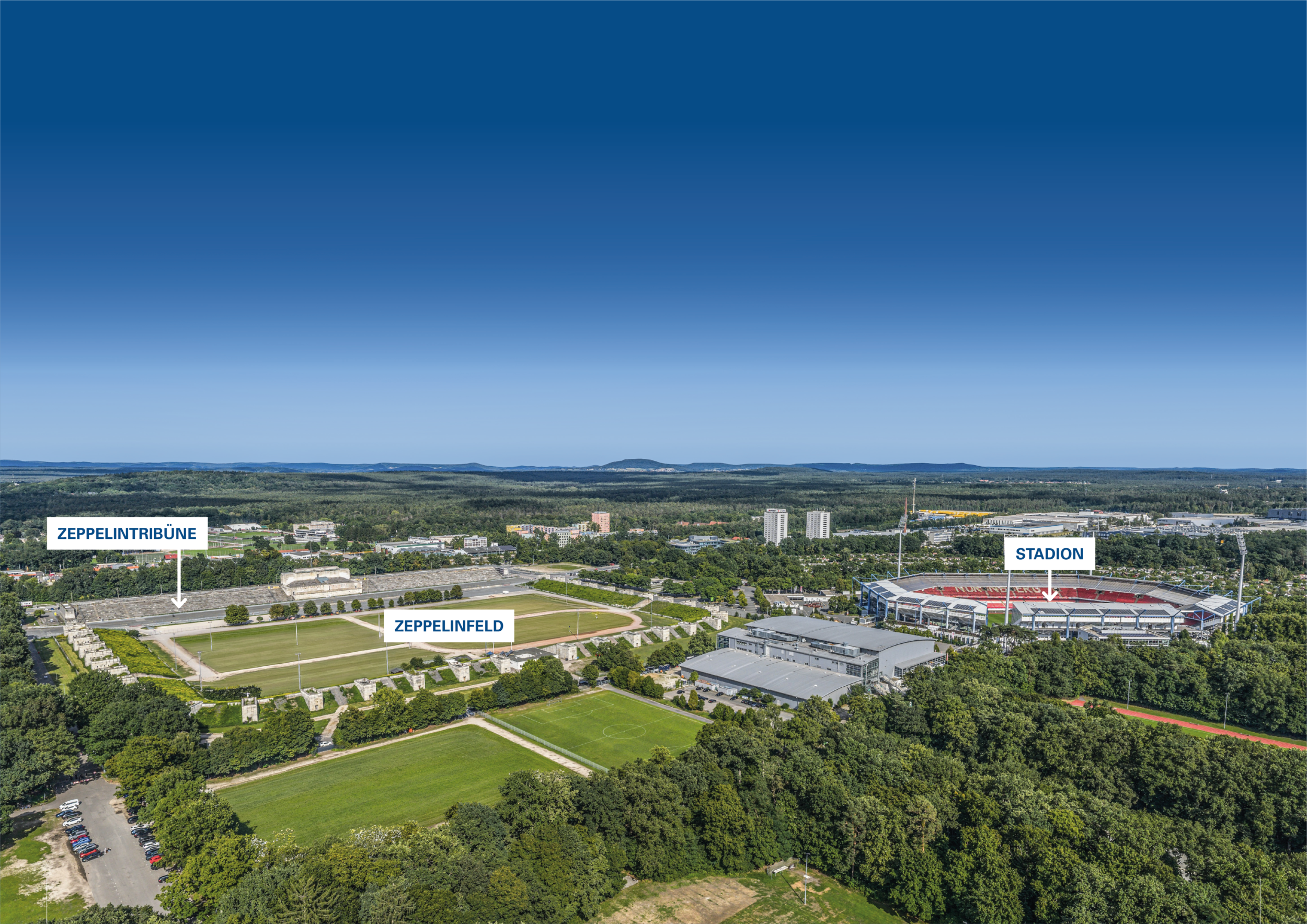
Ninety years have passed since the rushed construction of this structure, conceived as a “ceremonial space for the Nazi cult of heroism” – a project of particular importance to Adolf Hitler and his architect Albert Speer. Even at the time of its construction, the building was designed for a single purpose: it is purely stage-set architecture, created to impress rather than to serve a practical function. It stands as a symbol of the National Socialist regime's propaganda machinery. The surrounding field is framed by 34 towers. Their purpose? An imposing, militaristic exterior—while most of the interiors simply housed restroom facilities. The scale of the complex is equally striking. Covering around 140,000 square metres, the site includes the Zeppelin Grandstand, which stretches for more than 360 metres. From the front, visitors see monumental grandstands and a vast stepped structure, originally embedded into artificially raised earth embankments to accelerate construction. Above the central podium—where Hitler delivered his ideological speeches to the German people—a gigantic gilded swastika surrounded by a laurel wreath once dominated the façade. When American forces liberated Nuremberg in April 1945, one of their first actions was to demolish this symbol of Nazi power. The swastika was blown up on 22 April 1945.
DAS HISTORISCHE ZEPPELINFELD
1909
Count Ferdinand von Zeppelin landed his airship **LZ 6** on the meadow by Dutzendteich. The site has borne his name ever since.
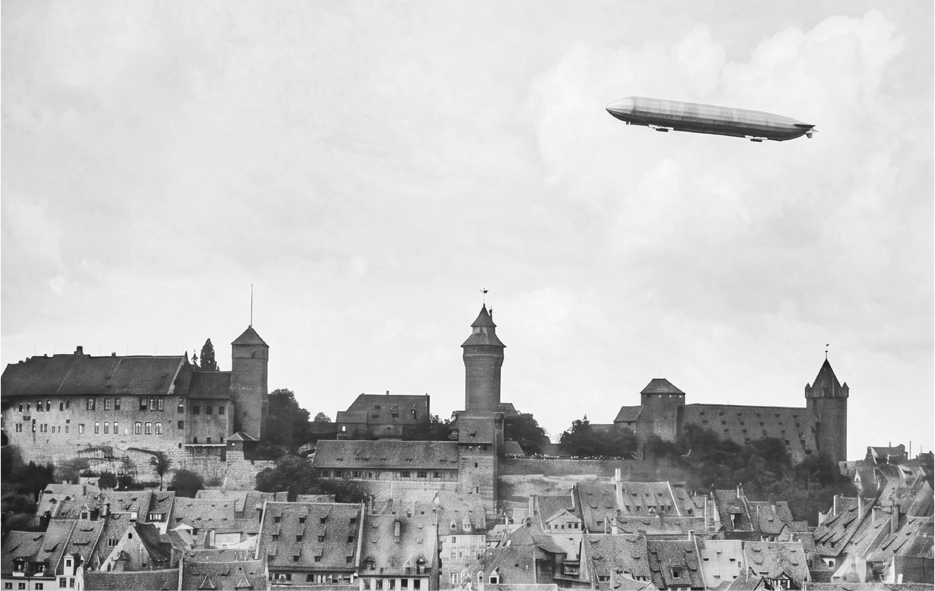
The airship flying over Nuremberg Castle before landing at Dutzendteich.
1928
Completion of the Dutzendteich People's Park under the democratic Mayor Dr. Hermann Luppe as a sports and recreational area featuring gymnastics and tennis courts on the Zeppelin Meadow, as well as what is now Max-Morlock Stadium.
1933 – 1938
The National Socialists use the site for their annual rallies and propaganda events, turning Nuremberg into the “City of the Nazi Party Rallies.” Here, Hitler stages himself before crowds of up to 200,000 people.
1935 – 1937
Construction of the Zeppelin Grandstand and its surrounding embankments based on designs by Albert Speer to stage Hitler's vision of the Reich and the "national community" (Volksgemeinschaft). The site became famous for the "Cathedral of Light," created using anti-aircraft searchlights.
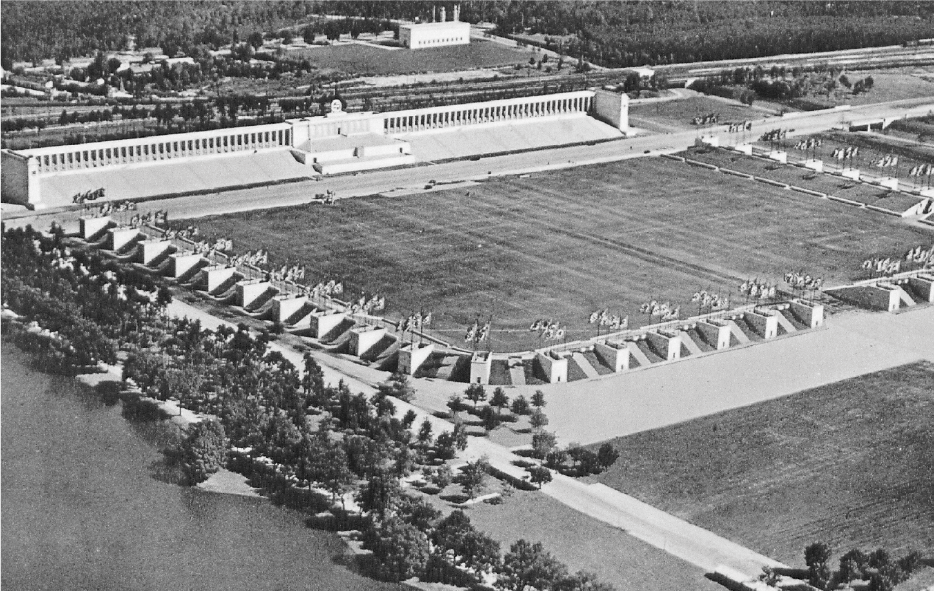
Postcard, c. 1938
1938
The last Nazi Party Rally is held on the site. From 1939 to 1945, no further NSDAP Party Rallies take place due to the Second World War.
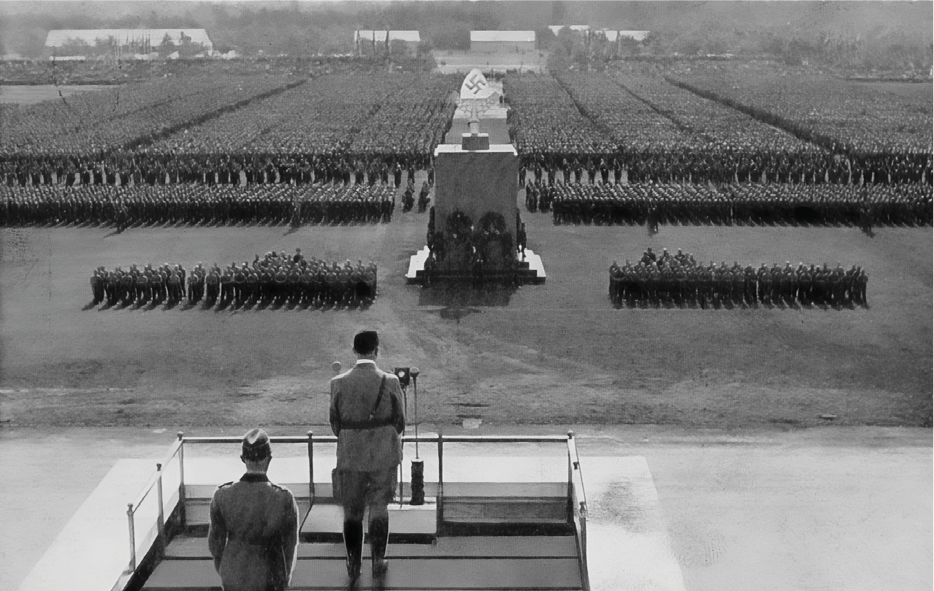
NSDAP Party Rally
1945
Following the arrival of the U.S. Army, the monumental swastika atop the central section of the grandstand is demolished by controlled explosion.
1967
Due to structural deterioration, the colonnades of the grandstand are demolished.
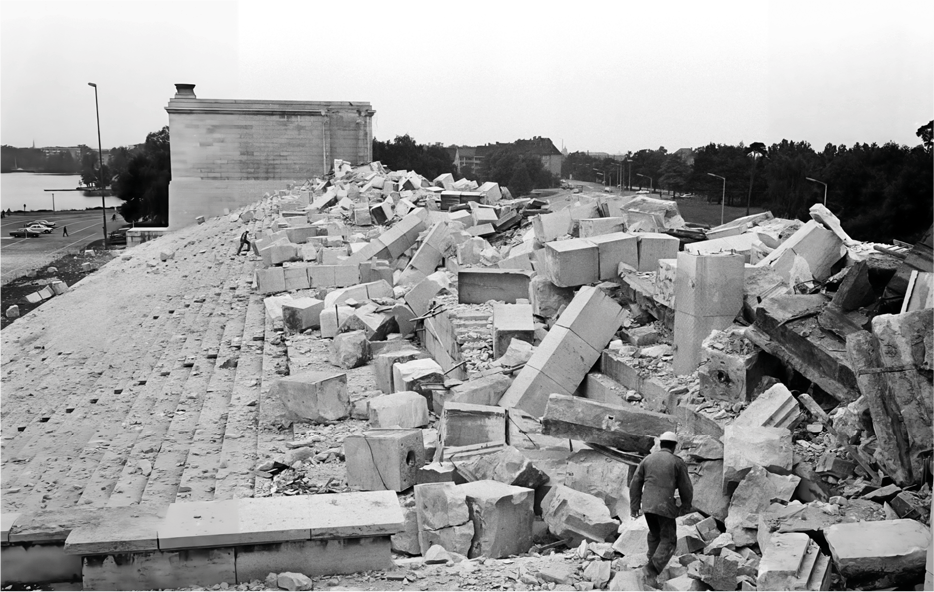
Demolition of the grandstand columns, 1967.
1983
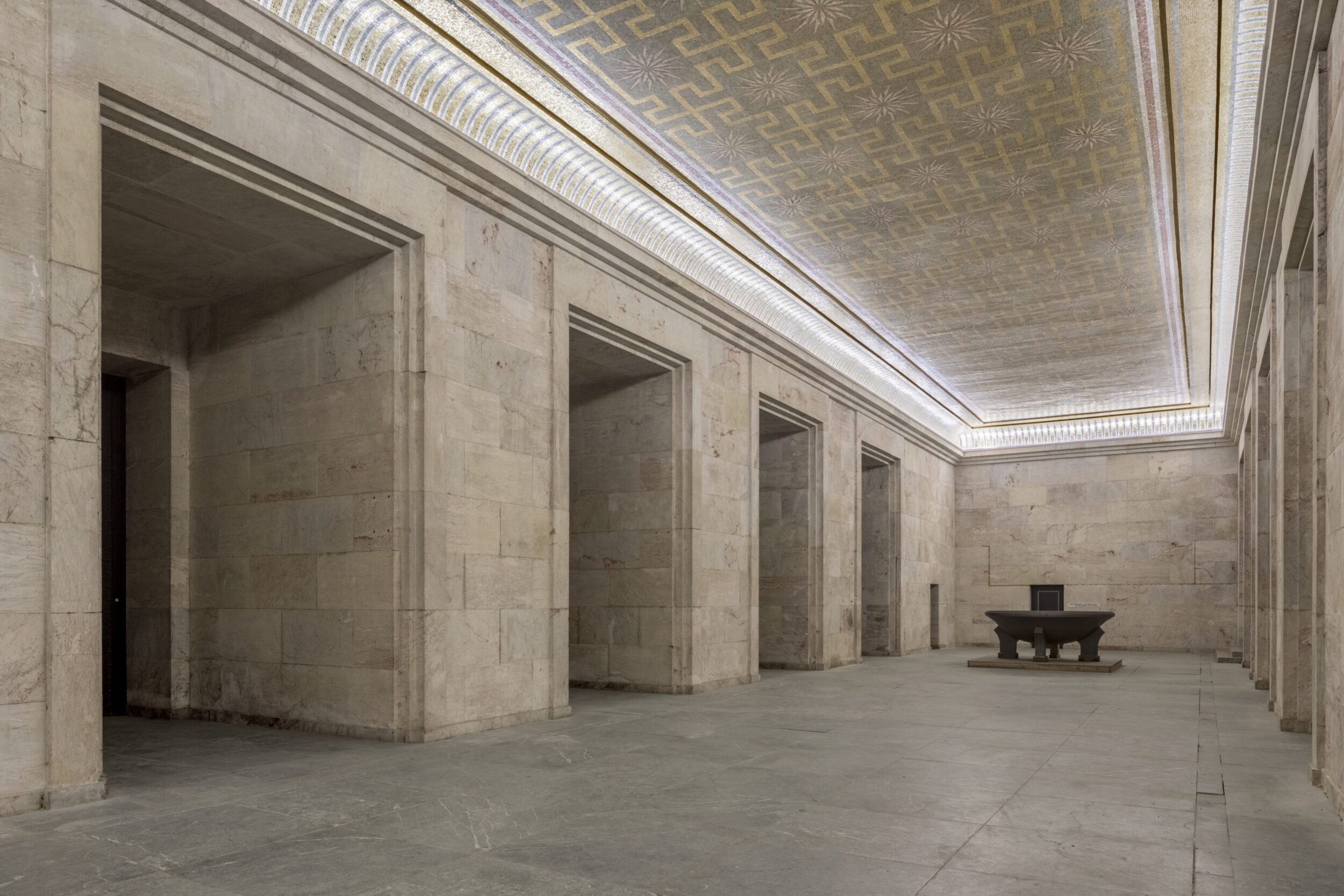
Restoration of the grandstand's interior, the "Golden Hall," for the exhibition Fascination and Violence, which was on display until 2001.
2011
The Cultural Affairs Committee adopts the "Learning Site Zeppelin Grandstand" concept.
THE INVISIBLE FIRST STEP: LARGE-SCALE HAZARDOUS MATERIALS REMEDIATION
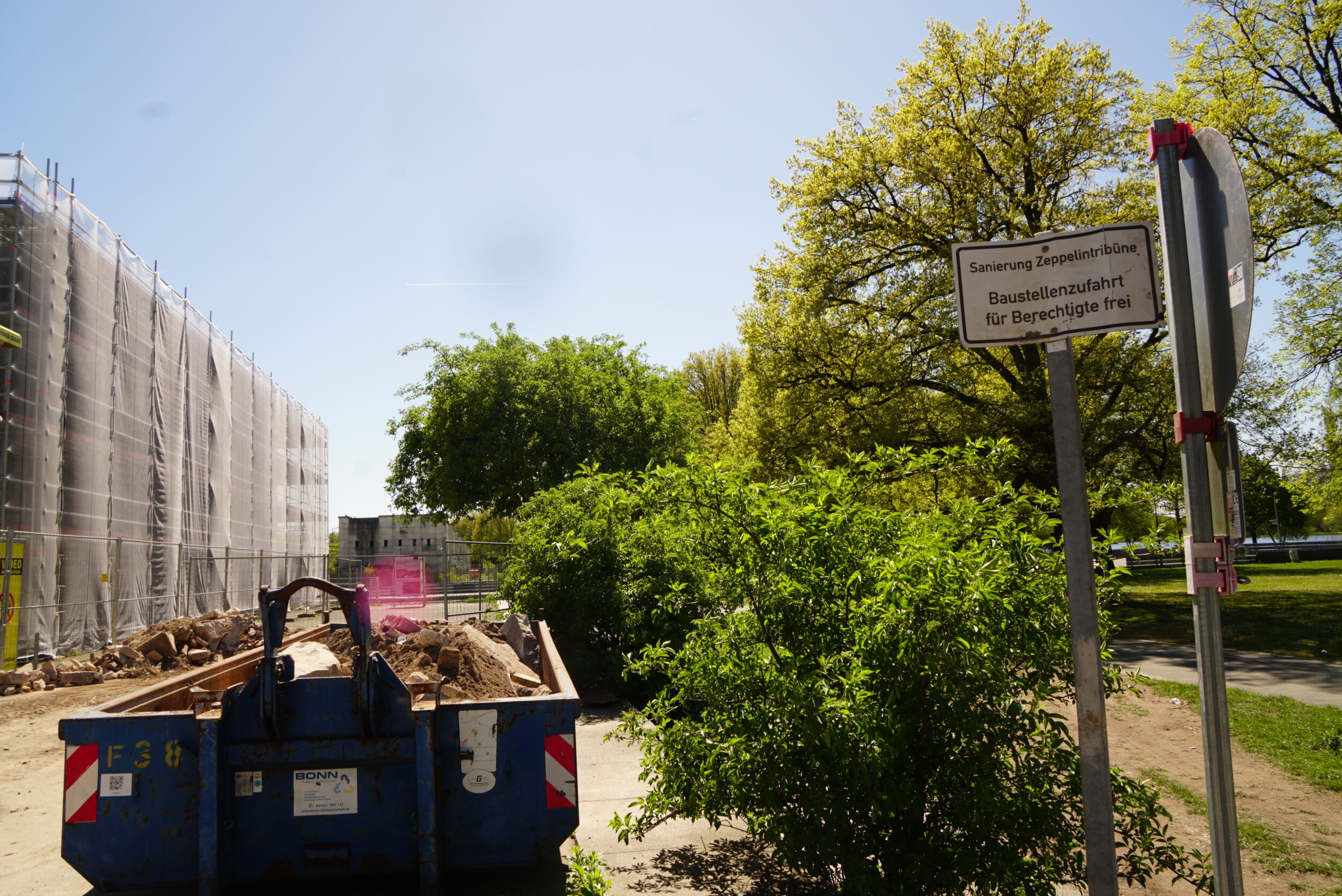
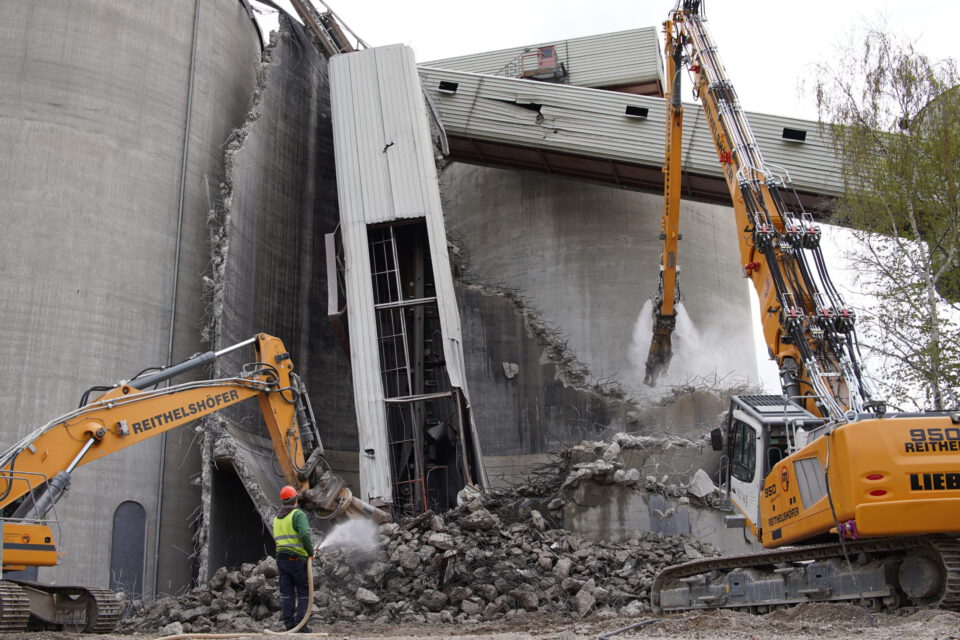
Before the construction work planned by the City of Nuremberg and the architectural firm FKK+P could begin, safety was the top priority. To ensure safe working conditions, the entire site first had to be meticulously examined for hazardous materials typical of the period in which it was built. Thanks to the early involvement of all project partners during the planning phase, LGA Institute for Environmental Geology and Contaminated Sites (LGA IUA) was brought into the project at an early stage. This proved to be a decisive advantage for the LGA IUA experts, enabling them to carry out a detailed assessment of all affected structural elements well before the main construction work commenced. The investigations revealed several critical findings. In addition to mould-contaminated support structures and façade coatings containing hazardous polycyclic aromatic hydrocarbons (PAHs), the experts identified one particularly significant issue: 27 kilometres of asbestos-containing joint sealants across all weather-exposed exterior surfaces. The sheer scale of this discovery presented the LGA IUA's asbestos specialists with a major logistical challenge.
A project of this scale requires tailored solutions. In close coordination with the Occupational Health and Safety Authority of the Government of Middle Franconia, a remediation approach was developed that proved highly efficient in terms of both time and cost, ensuring the safe removal of all 27 kilometres of asbestos-containing joint sealants before the main construction work began.
For more than a year, the entire hazardous materials remediation of the Zeppelin Field was continuously monitored by the expert team from LGA IUA under the direction of Dominik Kisskalt. Only after the final clearance had been granted by the LGA IUA specialists were the remediated areas released step by step for the subsequent construction phases.
“WE HAVE A DUTY TO ENSURE PUBLIC SAFETY – IT'S REALLY QUITE STRAIGHTFORWARD”
A closer look today reveals what even the untrained eye can see, summed up by Robert Minge as follows: “At its core, this is about the fundamental principles of structural stability.” Or, as Nuremberg's former Mayor Dr. Ulrich Maly put it rather matter-of-factly: “We have a legal duty to ensure public safety – it's really quite straightforward.” This is also why LGA is involved in all matters relating to public safety. Throughout the structure, masonry is crumbling, massive stepped stone blocks are cracked, and joints have failed. For a short time, demolition of the entire Nazi structure—including the magnificent Golden Hall inside—was considered because of public safety concerns and the high cost of preservation (around €80 million). The public debate surrounding this proposal is documented in numerous publications on the City of Nuremberg's website.
Those eager to learn—and fortunate enough to secure a place—can join one of the guided tours of the site offered by the Documentation Center Nazi Party Rally Grounds or speak with Dr. Matthias Braun. His reasoning for preserving this authentic place of learning in its current condition is compelling: “This architecture represents, in a way that is unique in Europe, the physical expression of an ideology that we reject. It can serve as an exemplary place of learning.”
Hitler intended this monumental setting to do more than merely proclaim his concept of a strictly hierarchical “national community” (Volksgemeinschaft) based on racist ideology—from a position of literal and symbolic superiority. It was meant to be tangible and experienced firsthand: by the Nazi leadership on the grandstand, by the paying spectators below, and by the marching soldiers and chanting members of the Reich Labour Service. The ideological construct of the “Volksgemeinschaft” was to be physically felt and reflected in the architecture itself. Those who belonged were inside, on the field. Those who did not belong remained outside. A monument in stone to the Nazi regime's ideology of persecution and annihilation.
PLACE OF LEARNING, MEMORIAL, AND RECREATIONAL AREA
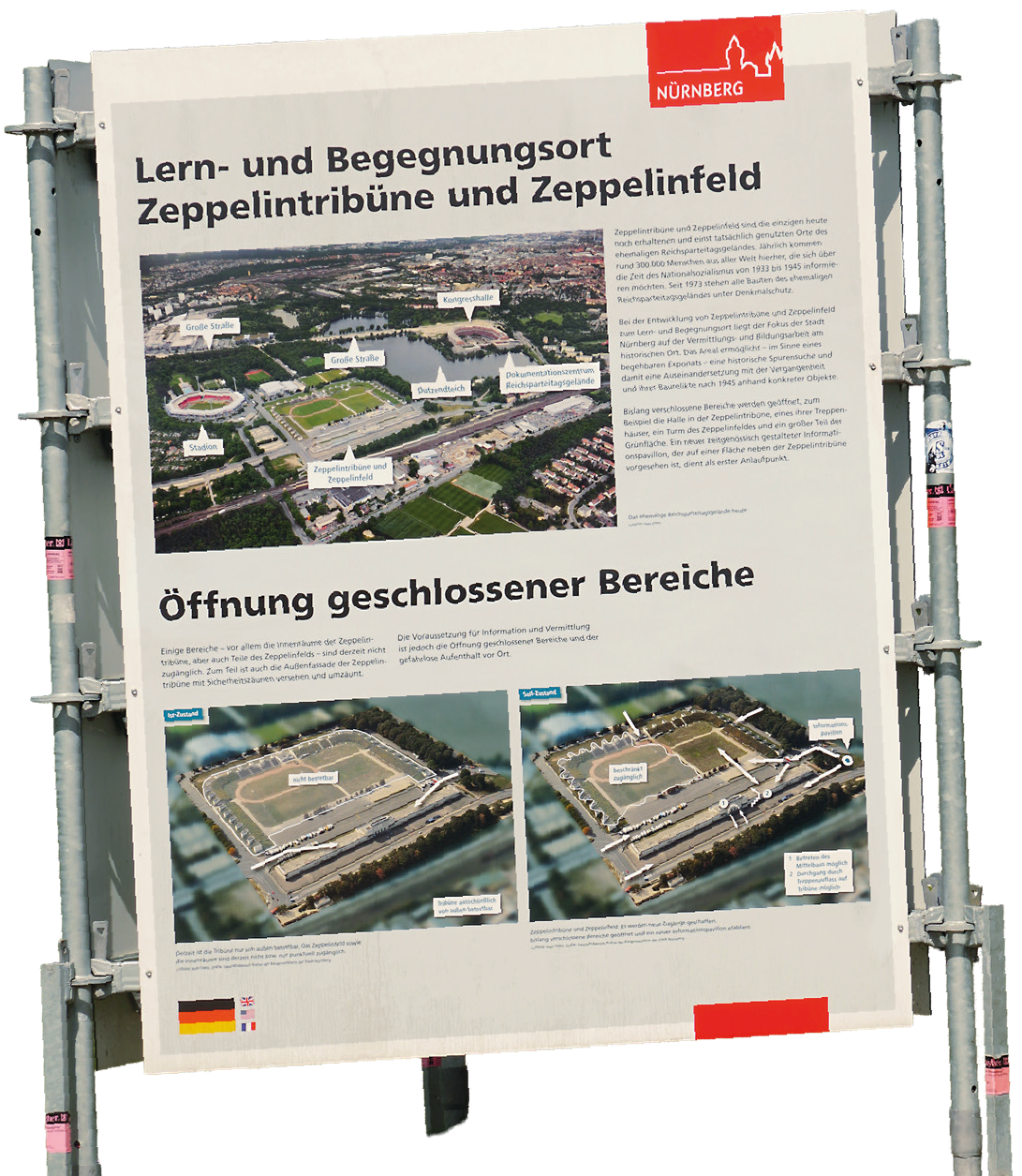
The Zeppelin Field has long served as both a place of historical learning and a memorial. Due to its ongoing deterioration, the site is currently undergoing a large-scale restoration project. At the same time, the field has been used peacefully for many years. Following extensive discussions, a consensus was reached to preserve the site. The primary objective is to ensure that the grandstand and its surroundings are safe for visitors and public use. The site is to be preserved in its current condition. What has been lost will not be reconstructed—let alone the completion of Albert Speer's ambitious plans for the entire Nazi Party Rally Grounds, which were abandoned with the outbreak of the Second World War.
A TOUR WITH GREGOR STOLARSKI
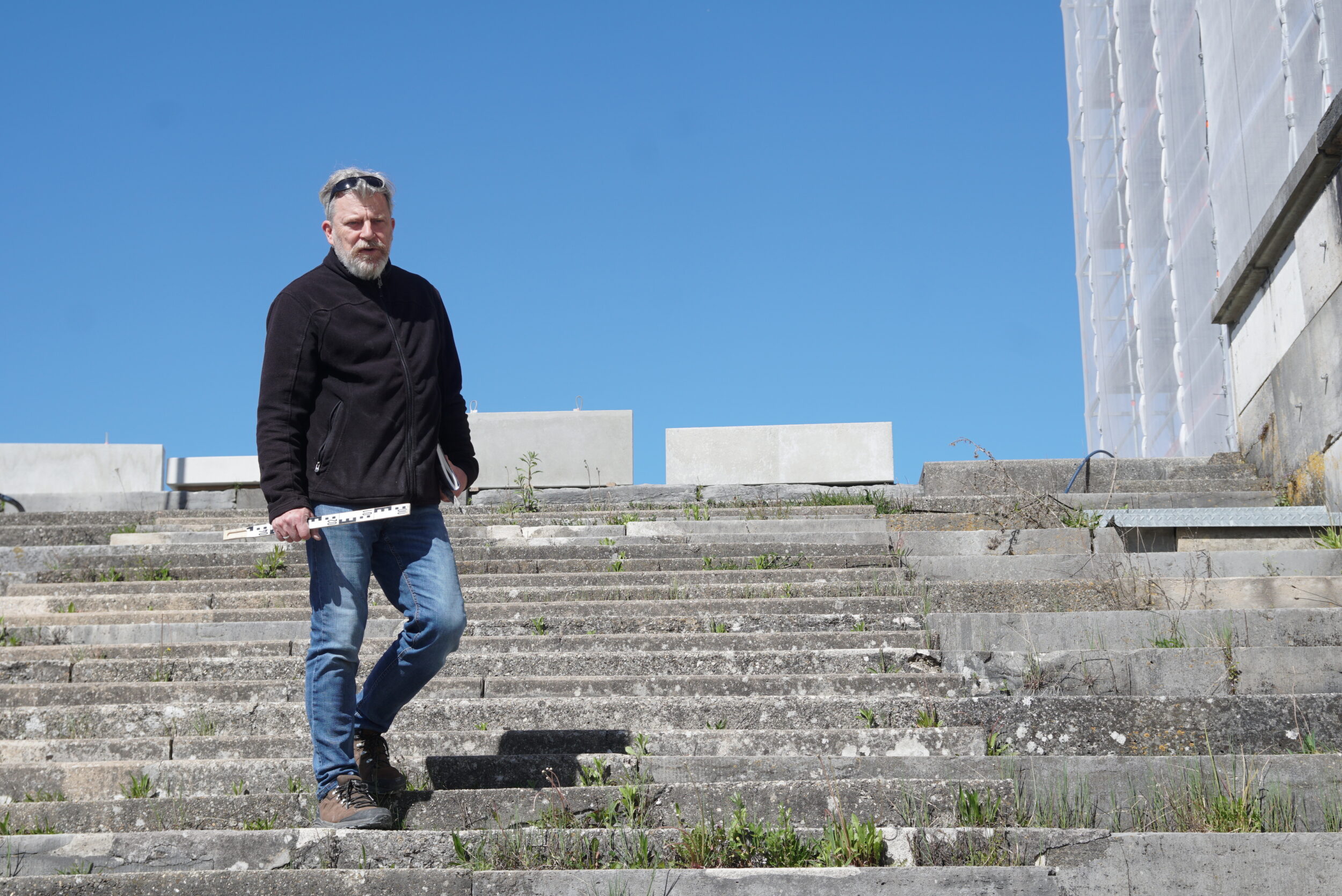
The tour with Gregor Stolarski, regarded within LGA as a “master of sandstone craftsmanship” and a true detective when it comes to historic stone structures, begins in the Golden Hall—a space of more than 300 square metres with a ceiling height of nearly eight metres, crowned by shimmering gold mosaic ceilings created by Munich art professor Hermann Kaspar. Its purpose? To impress the “Führer.” “It's all stagecraft,” says Stolarski, leaving it open whether he is referring to the hall itself or to the entire structure. Today, the condition of the building reflects the legacy of the Nazi era, the abrupt halt to construction at the outbreak of the Second World War, wartime damage, and decades of attempts to repair what had been destroyed. Shrapnel and bullet marks on the exterior walls date back to 1945, while the powerful pressure waves from the major explosions caused extensive structural damage.
We walk up the steps of the grandstand. Hardly a single one is undamaged; the joints have been raked out. Large sections have broken away from some steps, others are crumbling, while some have been replaced entirely. For cost reasons, the damaged steps cannot be replaced on a one-to-one basis. “LGA is responsible for coordinating the properties of all key materials used on site, including natural stone, cast stone, mineral repair materials, and steel,” explains Stolarski, pointing to the repair patches and entire steps that have been restored. Rubble can be seen throughout the site.
The rear facade of the building presents its own set of challenges. “Should this shrapnel scar be repaired?” Stolarski asks. “In my view, it is part of the building's condition and an integral part of its history.” The façade panels are secured using individual metal anchors, each of which must be inspected separately. “More than a dozen experts from LGA are working together on this project—on site and in our laboratories. It takes an entire team to answer these safety-related questions,” Stolarski says, referring to his colleagues.
Over the decades, the site has served many different purposes. The field was first enthusiastically used for decades by American soldiers, who began hosting baseball and football league games on the lawn as early as 1945, with matches broadcast live to the United States. To this day, the annual Rock im Park festival attracts around 80,000 visitors per day. During the Norisring race, the grandstand provides seating for spectators. The walls at the rear of the Zeppelin Grandstand have also been used for tennis practice. All of these uses have been and continue to be intentional, provided the structures remain safe and do not deteriorate to the point where they must be closed to the public. To help prevent this, the Federal Republic of Germany and the Free State of Bavaria are supporting the City of Nuremberg with nearly €65 million. Once secured, the site is intended to serve both as a place of learning and as a venue for recreational activities.
Before that, however, there is still a great deal of work to be done.
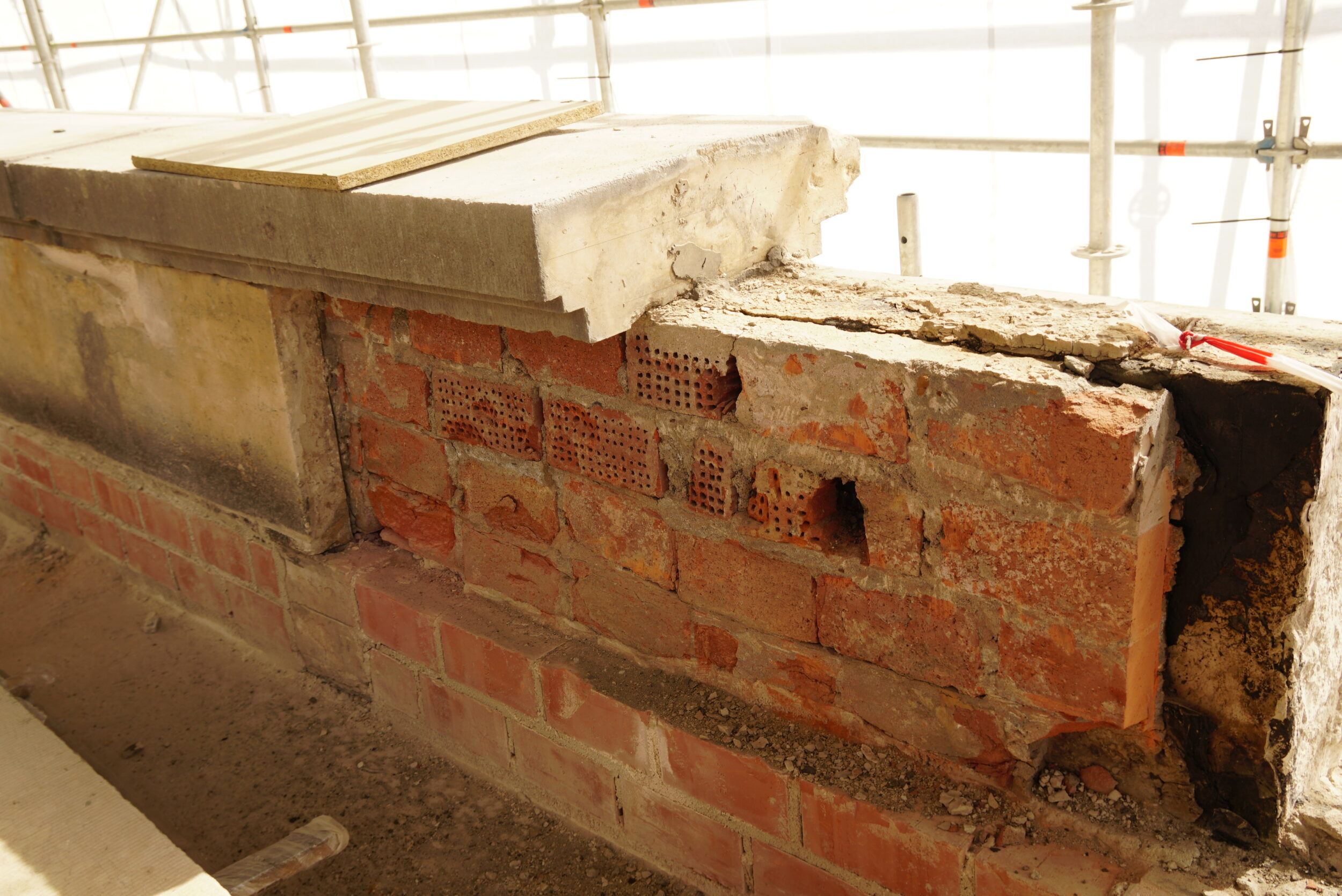
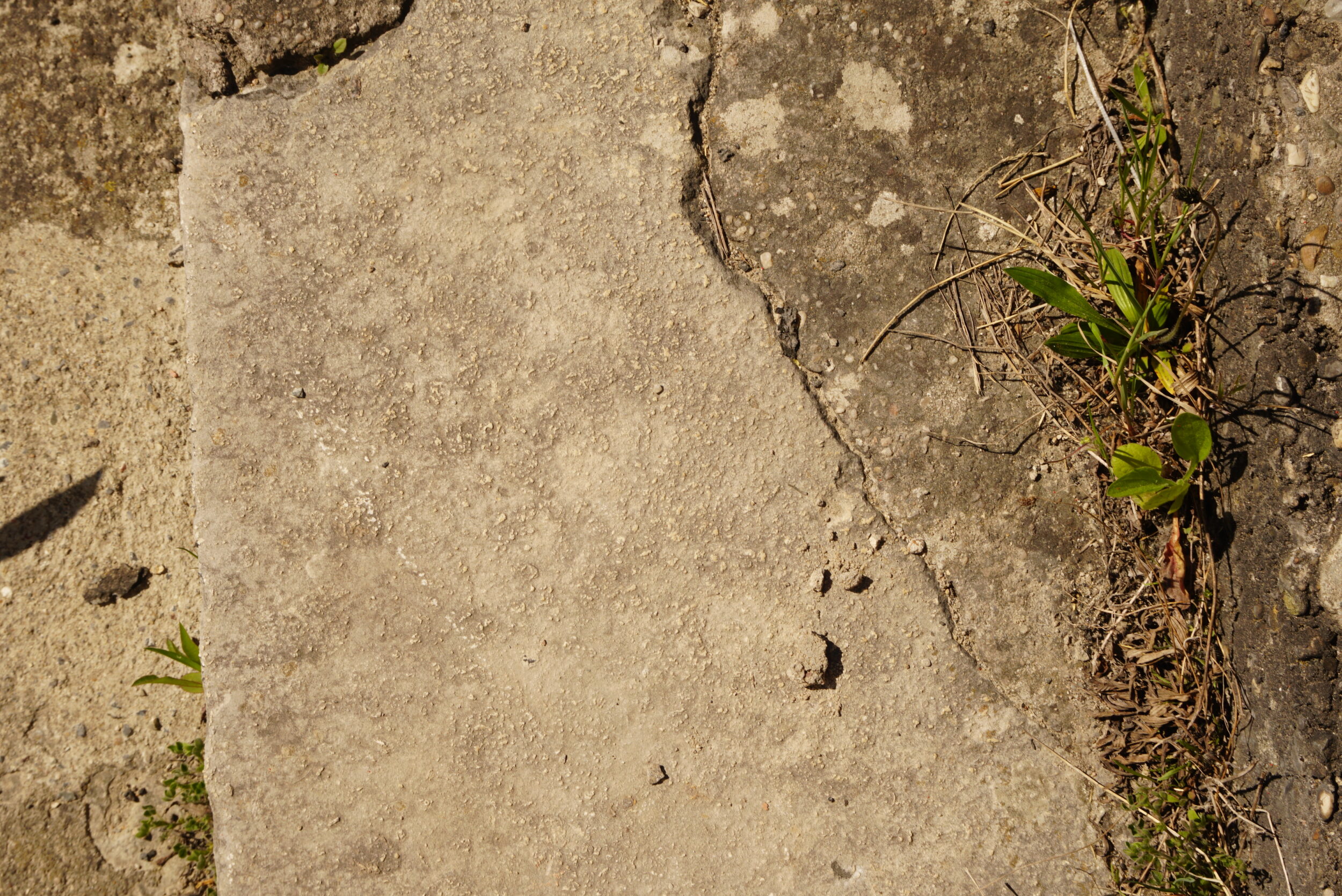
The historic Zeppelin Grandstand is crumbling in many places.
TEMPORARY STRUCTURAL STABILISATION
This historic structure presents a wide range of structural challenges, which were assessed by experts from various LGA disciplines. Mathias Weigelt, now retired, and his colleague Gabriel Graumann from LGA's Structural Design Review department were responsible for evaluating the steel structures in the eastern and western wings.
“When the columns were demolished,” the structural engineer explains, “the resulting pressure waves caused cracks in the structure. Debris fell onto one of the staircases. At the time, timber supports were installed to stabilise the building. These have since been replaced with steel supports.” The steel members have now been thoroughly inspected.
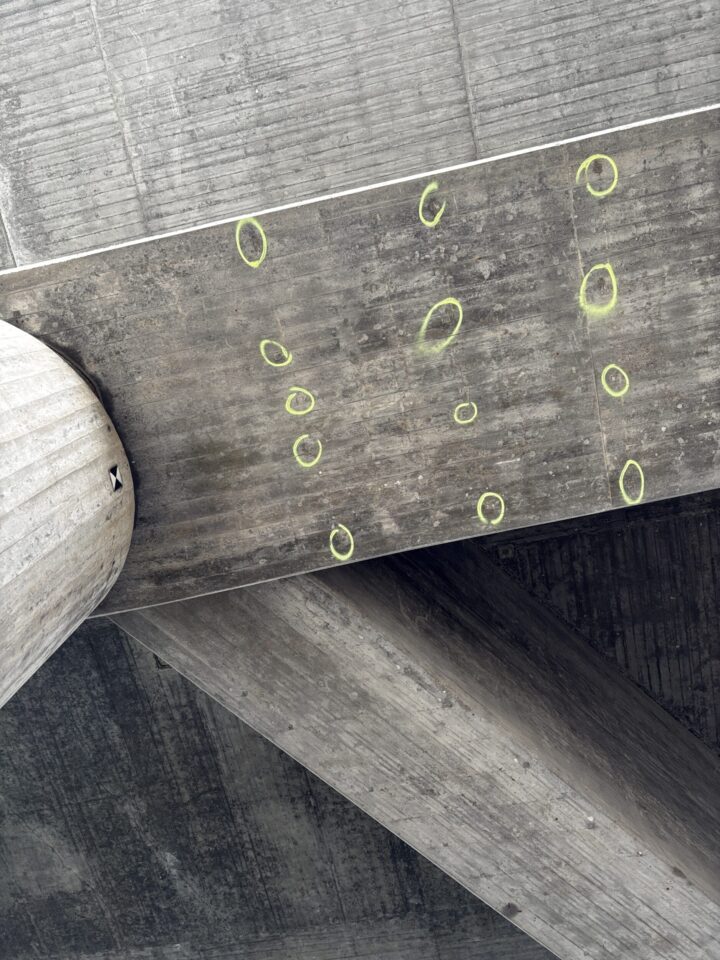
The team also inspected the reinforcement in areas where concrete had replaced the natural stone. In addition, a photovoltaic system had since been installed on the roof. “This structure is so extensive and complex that it is no easy task to keep track of everything that is relevant,” Weigelt concludes.