
LGA INSTITUTE FOR ENVIRONMENTAL GEOLOGY AND CONTAMINATED SITES GMBH POSSESSES THE EXPERTISE FOR MEASURING RADON CONCENTRATIONS.
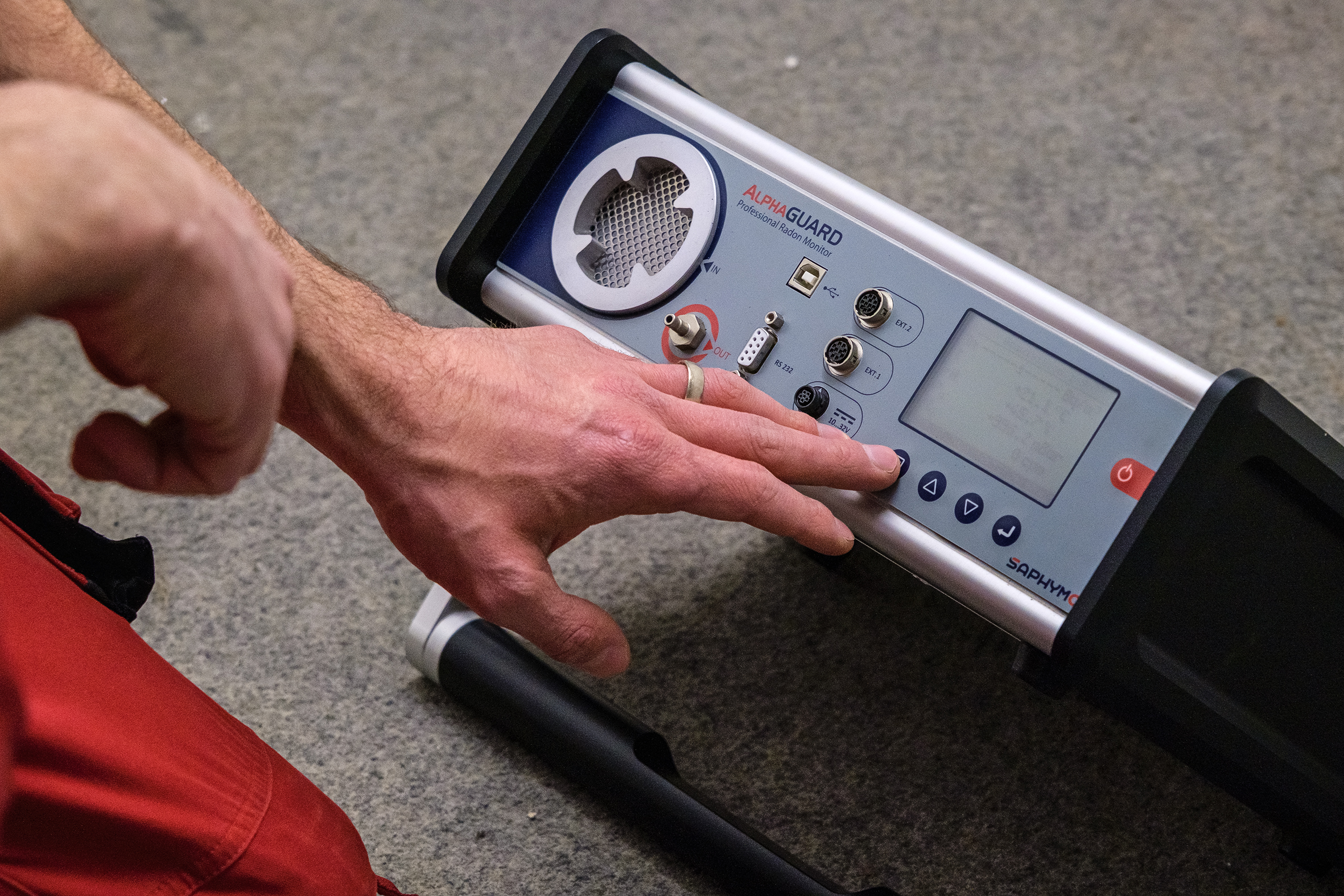
NOT ONLY RADON RISK AREAS ARE RELEVANT. SOIL AIR MEASUREMENTS ARE BECOMING INCREASINGLY IMPORTANT IN NEW CONSTRUCTIONS.
The dangers posed by radon are alarming: The noble gas, a decay product of uranium, which in turn is found in certain rocks (such as granite, sandstone, or claystone), can cause lung cancer in the long term. Outdoors, the danger from the colorless and odorless gas can be neglected due to low concentrations. However, if it penetrates buildings where people spend long periods and the concentration increases, radon becomes harmful to health: The International Agency for Research on Cancer (IARC) in Lyon, established by the WHO, classifies radon as a proven carcinogen for humans. The risk of developing lung cancer is greater the more radon is in the air and the longer the period during which radon is inhaled. Since the end of 2018, the federal radiation protection legislation has included new regulations for dealing with radon. The law stipulates, among other things, that radon precautionary areas must be designated nationwide. These are areas where it is expected that the annual average radon concentration in indoor air in a significant number of buildings (10%) with living or working spaces exceeds the legally established reference value of 300 becquerels per cubic meter (Bq/m³) of air. In Bavaria, the Fichtelgebirge with the district of Wunsiedel has already been designated as a radon precautionary area. Here, the LGA, on behalf of the State Office for the Environment (LfU), conducted radon measurements in the soil air.
In such areas, the experts from the LGA Institute for Environmental Geology and Contaminated Sites are deployed. Among them is environmental engineer Martin Kahnt. "Especially in workplaces in the basement or ground floor of older buildings, elevated radon concentrations can occur without anyone noticing," he warns. Regular ventilation helps, but in the long run, some old buildings need to be renovated. "The inspection obligation is the entry point into the topic," explains geologist and managing director Dr. Jürgen Kisskalt. "The LGA Institute not only has the expertise but also the equipment, such as precise measuring devices, that enable a reliable diagnosis." Such measurements can also make sense in non-risk areas. "Both in the building and in the soil," says Kahnt. "A radon analysis should be an integral part of any site investigation; in precautionary areas, it is already mandatory. This is required by the duty of care of the builder, even outside these areas." After all, the WHO already considers levels above 100 becquerels to be long-term health hazards.
NOBLE GASES – INCLUDING RADON
The noble gases form a group in the periodic table of elements that includes seven elements: helium, neon, argon, krypton, xenon, the radioactive radon, and the artificially produced, also radioactive, oganesson. Helium is by far the most common noble gas. Most noble gases were first isolated by the British chemist William Ramsay. Due to its short half-life of about 3.8 days, radon cannot be obtained in large quantities; it is an element from a radioactive decay series of uranium. When people generally refer to radon, they usually mean the isotope 222Rn.